Trada Casino reviews and trust signals: current facts vs stale offers
 Available in GB
Source and trust analysis
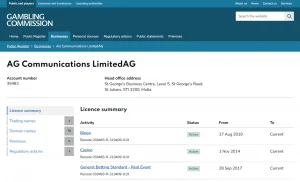
The original Trada Casino domain is inactive, so current regulator evidence should carry more weight than a recently updated review that still advertises bonuses or live play. The UK Gambling Commission lists tradacasino.com as Inactive under AG Communications Limited account 39483. Yet searches in September 2026 still return pages updated in 2026 that describe welcome bonuses, payment methods and even a live casino experience as if Trada were operating. That conflict is exactly why a fresh-looking date is not enough. Player complaints can add context, but they remain individual reports unless a regulator or other authoritative source establishes the underlying facts.
Table of Contents
- Start with a source hierarchy, not a star rating
- Why a September 2026 update date can still be misleading
- The UKGC licence and the inactive Trada domain are different facts
- What the 2025 UKGC action against AG Communications establishes
- How to read complaints without turning allegations into findings
- Be cautious with similarly named domains and claimed profiles
- A practical checklist for evaluating a Trada page in 2026
- Three checks can expose a stale casino review quickly
- What the regulator action should and should not change in a trust assessment
- For Trada in 2026, regulator status matters more than a fresh review date
Start with a source hierarchy, not a star rating
Trust research becomes confusing when every source is treated as if it answers the same question. A regulator register can establish the status of a licence or registered domain. A closure notice can establish that a service stopped operating. An affiliate review can preserve product history and commercial claims. A player review can describe one person’s experience. Those sources can all be useful, but they do not carry equal evidentiary weight.
For Trada, the strongest current brand-level signal is the UKGC domain-names record for AG Communications Limited, which marks tradacasino.com as Inactive. The Trada domain-status guide explains how that entry fits alongside the company’s broader licence record.
| Source type | Best use | Main limitation |
|---|---|---|
| UKGC public register | Current licence and domain status | Does not review every user transaction |
| Current closure notice/reporting | Whether the former service stopped operating | May not resolve individual account disputes |
| Affiliate/review page | Historical product context and search examples | Can retain stale offers or monetised language |
| Player complaint/review | First-hand account of an individual experience | Not automatically verified as a general fact |
Why a September 2026 update date can still be misleading
A useful real-world example appears in current search results. Betting.co.uk has a Trada review marked as updated on 7 September 2026, yet the page still introduces two sign-up offers and discusses a no-deposit bonus and matched-deposit offer. Another page, Legit.Casino, shows an August 2026 update while presenting Trada as legitimate and safe to play at, advertising a welcome bonus and listing current-looking banking and withdrawal details.
The issue is not that every historical detail on those pages must be false. The issue is that the current operating-status claim conflicts with the regulator’s inactive-domain record. A review can be edited recently while part of its underlying product template remains stale. “Last updated” therefore proves that a page was modified, not that every commercial claim was revalidated against the live operator and regulator records.
This is why the current Trada status should be checked before any bonus, game or payment claim. The original closed operation has no verified current UK welcome offer. A page that advertises one should be treated as historical or stale unless it can show a current official operating route that matches the regulated domain evidence.
The UKGC licence and the inactive Trada domain are different facts
AG Communications Limited still appears in the UK Gambling Commission register with an active remote casino licence. That is a current fact about the legal licensee. It does not override the separate fact that tradacasino.com is inactive. Treating the company-level licence as proof that Trada itself is live would collapse two different register fields into one conclusion.
The Trada UKGC licence status page covers that distinction in detail. For trust research, the practical lesson is that a legitimate licence reference can appear on an old review even after a particular brand domain has been retired. The licence reference may remain historically connected with the brand, while the active-domain status has changed.
That is also why this page avoids a one-word verdict such as “safe” or “unsafe”. A regulator record can establish licence and domain facts. It cannot guarantee the outcome of every historical player interaction, and an inactive brand is not a current casino service to evaluate in the same way as a live operator.
What the 2025 UKGC action against AG Communications establishes
The UKGC’s current regulatory-action record for AG Communications Limited shows a settlement with a decision date of 4 February 2025. The Commission says its review found failings in anti-money-laundering and counter-terrorist-financing controls and in social-responsibility controls across periods between 2022/2023 and 2024. The outcome included a payment in lieu of a financial penalty of £1,407,834, divestment, Commission costs and a public statement.
That is strong regulator evidence about the licensee and the compliance failings described by the Commission. It should be reported at that scope. It does not establish that every Trada transaction was mishandled, that every historical complaint was proven, or that a specific former player’s account was affected in the way an online review alleges.
The action is therefore relevant to a trust analysis, but it should not be inflated into claims the regulator did not make. The UKGC record concerns AG Communications Limited’s controls and specified licence-condition breaches. Individual Trada disputes still need their own evidence.
How to read complaints without turning allegations into findings
Long-running review sites contain both positive and negative Trada player comments. Some users praise payouts or support; others complain about withdrawal delays, bonus handling or customer service. Those comments can reveal the kinds of issues players cared about, but they are not a substitute for adjudicated complaint records or regulator findings.
The correct editorial treatment is attribution. A player can report that a withdrawal took a certain amount of time, or that support responded in a particular way. That tells you what the reviewer says happened to them. It does not prove that the same experience was typical, that the operator breached a rule, or that an identical issue would have affected another account.
This matters even more after closure. New-looking reviews posted against similarly named or newly claimed profiles can create the impression of ongoing service. Before using any such post as evidence about the original Trada operation, verify that the reviewer is actually referring to the same historical domain and operator context.
Be cautious with similarly named domains and claimed profiles
One of the easiest mistakes after a brand closes is to assume that any website or profile using the old name belongs to the original operator. The UKGC register provides a concrete anchor: the domain associated with the historical Trada record is tradacasino.com, and it is inactive. A different domain that uses “Trada” in its name should not be treated as official merely because the branding looks familiar.
This is especially relevant when a review platform displays a recently claimed company profile or current-looking bonus copy. The existence of the profile does not, by itself, prove continuity with the original regulated casino. Verify the domain, legal entity and regulator record independently before sharing account data or making a payment.
Former customers who need practical help should use the former Trada player guide rather than following an unverified mirror or promotional page.
A practical checklist for evaluating a Trada page in 2026
- Check whether the page identifies the exact domain it is discussing.
- Compare that domain with the UKGC account’s current domain list.
- Separate the licensee’s active corporate licence from the status of the Trada domain.
- Treat current-looking bonus, game and cashier claims as suspect if they conflict with the inactive-domain record.
- Use review-site product details as historical context unless current operation is independently verified.
- Read player complaints as attributed reports, not automatic findings of misconduct.
- Use the UKGC’s 2025 action only for the specific licensee-level failings and outcomes the regulator actually records.
- Do not assume a similarly named domain or newly claimed profile is the original Trada Casino.
This checklist does not require dismissing every third-party source. It simply matches each source to the question it can answer reliably. Historical reviews remain useful for the former Trada games, payments and mobile record. Current regulator records remain the better source for present operating status.
Three checks can expose a stale casino review quickly
First, compare the domain named or linked by the review with the regulator’s domain list. For Trada, that immediately reveals the key mismatch when a page writes in the present tense: tradacasino.com is inactive. Second, look for claims that require a live product, such as a sign-up bonus, deposit button, current withdrawal timetable or mobile access. If those claims are present, ask what current source proves that the original casino is accepting new customers. Third, check whether the review distinguishes the legal licensee from the brand domain. An active company-level licence is not the same thing as an active Trada website.
These checks are deliberately simple. They do not require deciding whether the reviewer acted carelessly, whether a page is automated or whether an old commercial relationship still exists. They focus on observable evidence. That keeps the analysis factual and avoids guessing about motives.
What the regulator action should and should not change in a trust assessment
The 2025 UKGC settlement increases the amount of verified compliance context available for AG Communications Limited. It is therefore stronger evidence than an anonymous complaint when discussing the specific AML, customer-interaction, identification, disclosure, reporting, rules-display and self-exclusion requirements listed by the Commission. But the settlement still has defined boundaries. It covers the licensee and specified periods and controls; it is not a regulator declaration that every historic Trada game, bonus, withdrawal or customer interaction was improper.
Keeping that scope intact prevents two opposite errors. One is minimising a documented regulator action because some users posted positive reviews. The other is using the settlement as proof of every negative allegation ever posted about Trada. A careful trust page does neither. It reports the regulator findings directly, then keeps individual customer reports in a separate evidentiary category.
For Trada in 2026, regulator status matters more than a fresh review date
The central trust lesson is not that every old Trada review should be ignored. It is that current status must be established before historical product information is reused. A page can have a 2026 date and still carry live-looking bonus or payment claims that no longer match the original casino’s status.
As of 28 September 2026, the UKGC domain record provides the clearest current anchor: tradacasino.com is inactive. AG Communications Limited’s broader licence record and 2025 regulatory settlement are separate facts that add context but do not make the Trada domain active again. Read complaints as reports, promotional pages as secondary material and the regulator register as the primary source for current licensing and domain status.